
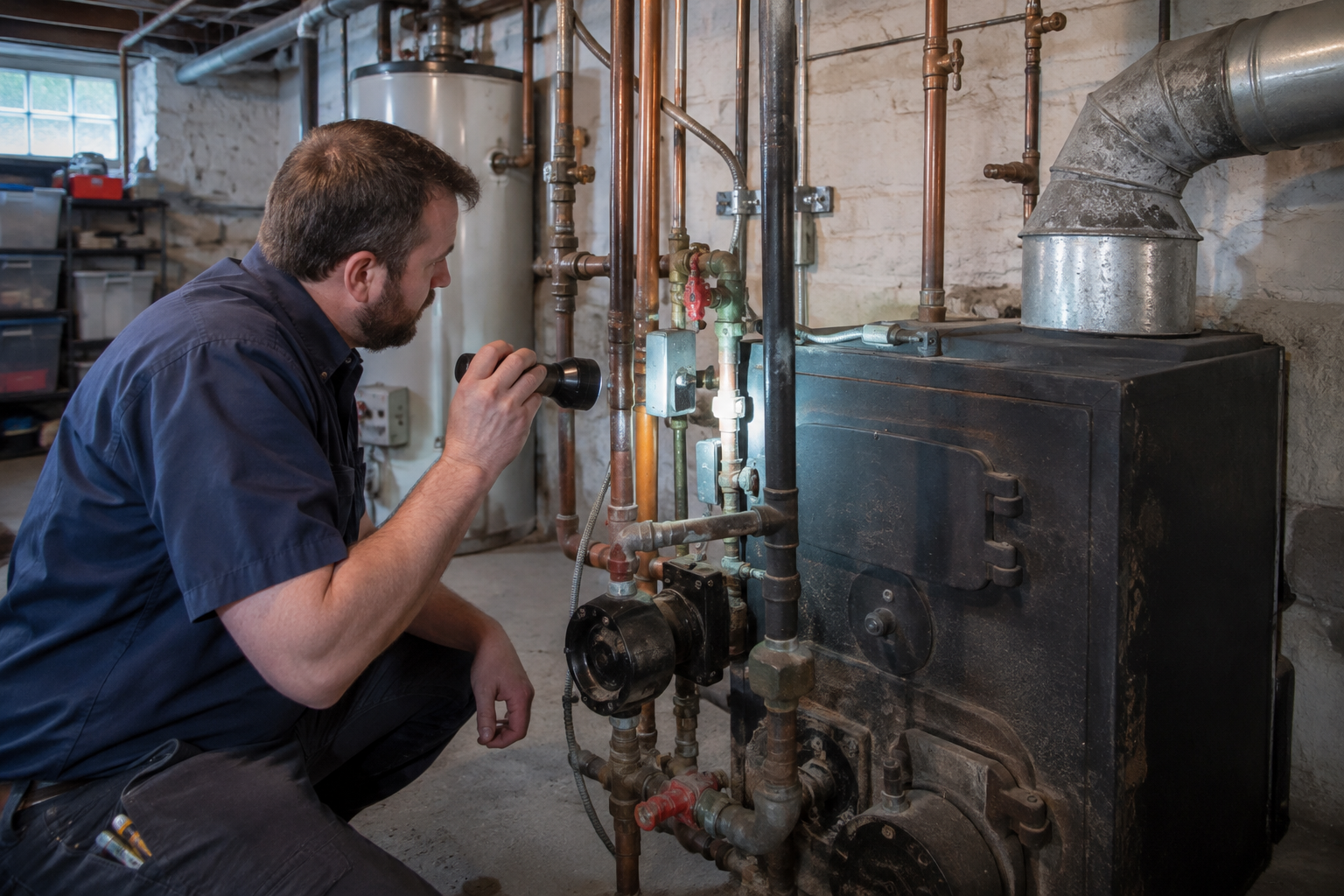
Most residential boilers last about 15–30 years, although design and upkeep make a big difference. Traditional cast-iron boilers often serve for 20–30 years or longer, while many high-efficiency condensing models have an expected service life closer to 15–20 years. These are planning ranges, not expiration dates: an older boiler’s condition matters more than its birthday.
For an aging system, the useful question is which parts have aged—and how. A circulator, control or expansion tank may need replacement while the boiler’s main heat exchanger remains sound; replacing those components does not reset the age of the boiler itself. In contrast, a leaking or badly deteriorated heat exchanger can make continued investment difficult to justify. Homeowners in Carnegie can start an October check-in by gathering the installation date, model number and service records rather than assuming age alone means replacement.
Water conditions play a major role in how long a boiler survives. In a closed-loop hot-water system, frequent additions of fresh water can introduce oxygen and minerals that contribute to corrosion and scale, so recurring water loss deserves investigation rather than routine topping off. Steam boilers have different water-management needs, making equipment-specific maintenance especially important. Water treatment should follow the manufacturer’s requirements and professional testing—not a homeowner’s guess about which additive might help.
The best way to extend service life is to schedule professional maintenance at the interval the manufacturer recommends, typically annually. That visit should address combustion, venting, safety controls, leaks and operating conditions, along with cleaning and other tasks specific to the boiler’s design. For a homeowner in Sewickley whose maintenance history has gaps, an October service appointment can establish a documented baseline before heavier winter use. Keep the area around the equipment accessible, and leave burner adjustments, pressure settings and internal cleaning to a qualified technician.
Longevity also depends on how hard the equipment has to work and whether the surrounding system supports proper operation. Incorrect sizing, poor water circulation or unsuitable control settings can create unnecessary operating stress, even when the boiler still produces heat. Ask your technician to assess the system as a whole and record any developing concerns, so future visits can distinguish a stable older boiler from one that is deteriorating. Fixing small leaks promptly and keeping a consistent service history are more useful than chasing an arbitrary replacement age.
If your boiler is approaching or beyond its typical lifespan, use this October to build a plan rather than rush into a decision based on age alone. Contact MRT HVAC Contracting for professional boiler maintenance and an assessment of your aging heating system. Our family-run team has served Greater Pittsburgh for over 30 years and can help you understand its condition, prioritize care and prepare for eventual replacement.
Need a hand with your system?
MRT HVAC serves Greater Pittsburgh with repairs, replacements and 24/7 emergency service.